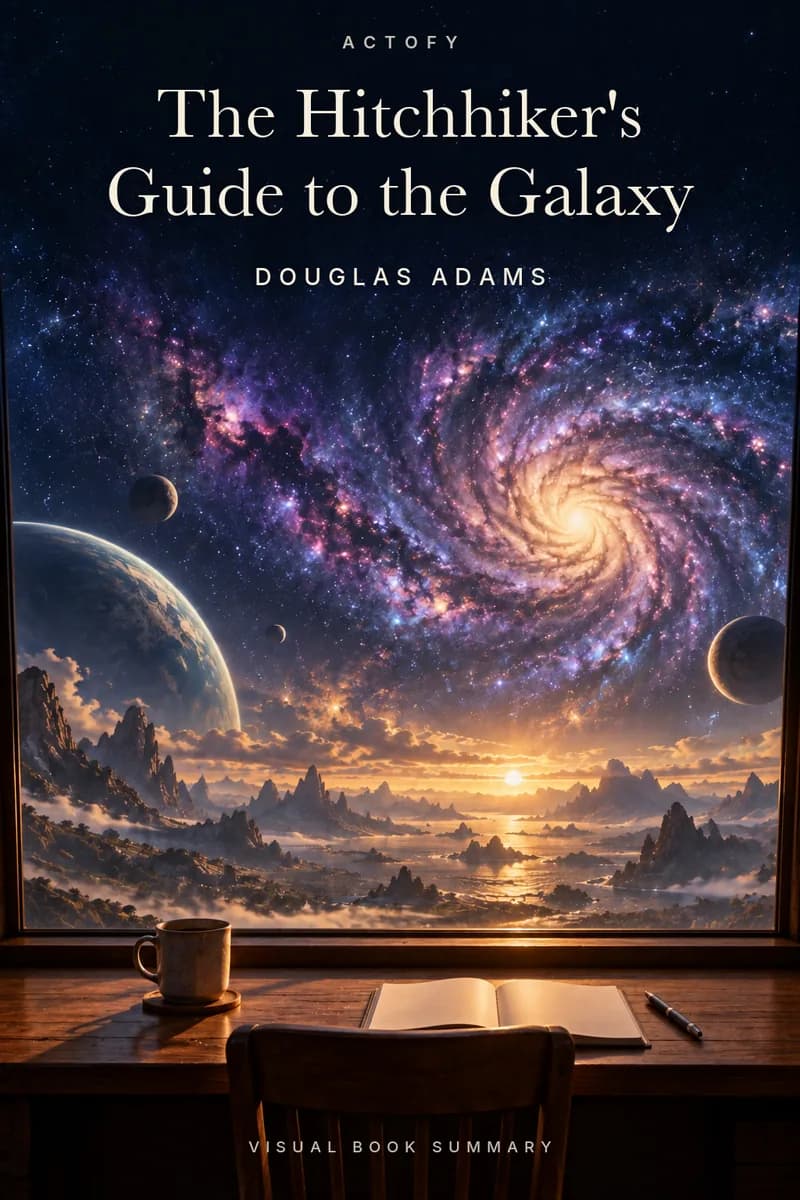
The Hitchhiker’s Guide to the Galaxy
by Douglas Adams
Last updated
The Hitchhiker’s Guide to the Galaxy is Douglas Adams’s 1979 comic novel. Actofy’s pages are a companion essay: original illustrations and commentary on a few of its themes, such as how quickly the ordinary can turn strange and how procedure can drift away from purpose. They do not retell the story.
The essay is spoiler-light and does not recreate the book’s scenes or dialogue. The three ideas below are themes, each shown with an original editorial metaphor.
Three ideas from the illustrated pages
Three pages from the pack, shown as they appear in the app. Visuals and narration are AI-generated.

Idea 1
The ordinary can become strange in a moment
Adams’s comedy unsettles the scale at which ordinary worries seem important. Familiar routines meet a universe that does not organize itself around human expectations. The humor creates distance without requiring the reader to stop caring about small human needs.
Example: Editorial metaphor: a desk-sized problem sits beneath a window full of galaxies.

Idea 2
Bureaucracy can hide the purpose it serves
The novel repeatedly treats procedure as absurd when official certainty becomes detached from human consequences. The comic target is not organization itself. It is a system that can explain its process perfectly while failing to account for what it does to people.
Example: Editorial metaphor: a clerk stamps an empty sheet while a queue circles the building.
Idea 3
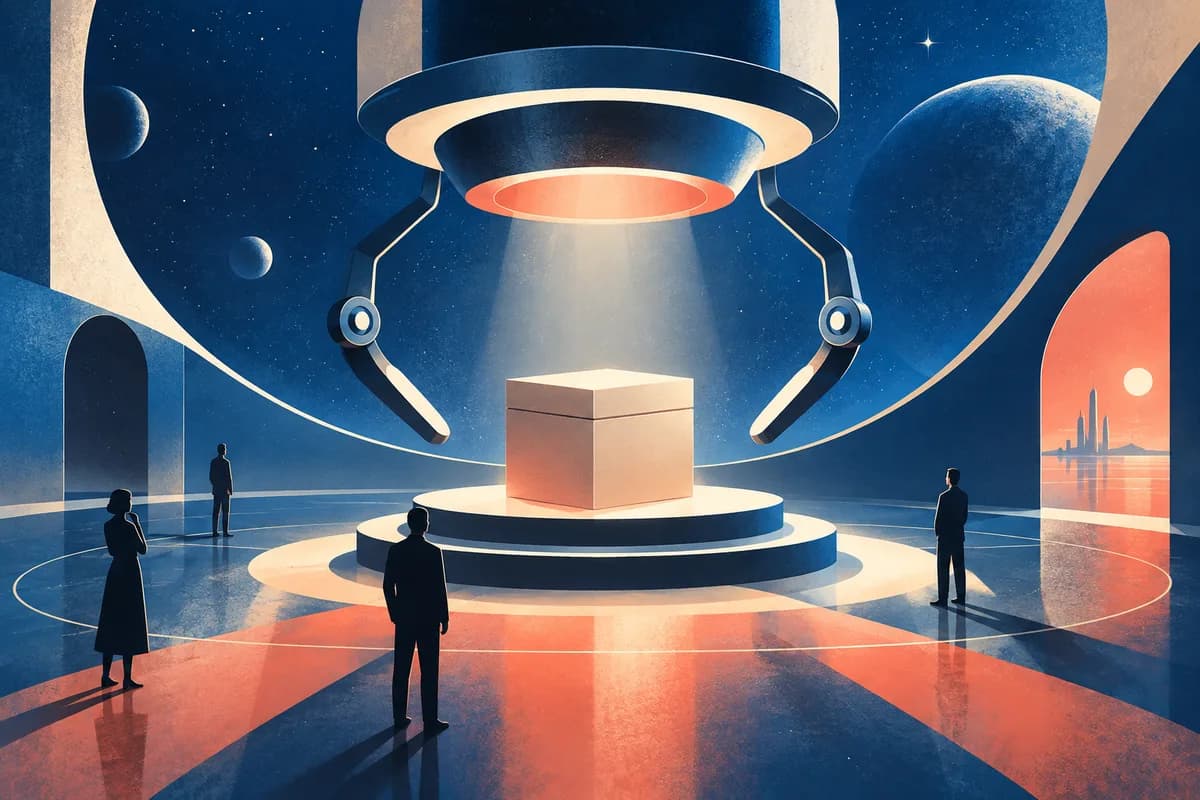
An answer needs a question
One of the book’s central jokes exposes the emptiness of an impressive answer when the underlying question is unclear. The critical point travels beyond the joke: precision is not the same as relevance. A measurement can be exact and still fail to explain what matters.
Example: Editorial metaphor: a polished machine delivers a beautiful sealed box to someone who never placed an order.
What is available in Actofy today
- Read visually
- Illustrated pages you can flip through. Available.
- Watch
- Video is in the works.
Create a free account to preview The Hitchhiker’s Guide; what a preview includes varies by title. Actofy Pro unlocks the full library and every chapter.
Who this is for
- You have read the novel and enjoy thinking about what its comedy is about.
- You have not read it and want a spoiler-light sense of its themes before you start.
Who it is not for
If you want the story, the characters or the jokes, read the novel. This page is not a plot summary and not an adaptation.